
Your migraines keep coming back, but your sick days are running out!
That pressure can lead people to look for additional support alongside their prescribed treatment.
Some turn to homeopathy in the hope of being able to go into great detail about their migraine triggers and their daily lives during a consultation.
If you’re considering homeopathy for migraine in Brampton with Soul Homeopathy, here are 5 things to know before you book.
- What migraine is and how it disrupts daily life
- The most common symptoms and triggers
- How a homeopathic consultation works
- Where homeopathy stands beside proven treatment
- What to check before you book
Note: Research has not shown that homeopathic remedies reliably relieve migraine. So, homeopathy should never replace proven migraine treatment.
What are migraines and how do they affect daily life?
Migraine is a neurological disorder characterised by recurrent attacks of moderate to severe headache, usually accompanied by nausea and sensitivity to light and sound.
Untreated headache attacks typically last 4 to 72 hours, long enough to disrupt a workday or a night’s sleep. Migraine Canada estimates that migraine affects about 14% of Canadians, or roughly 5 million people. Common, but not mild.
Yet migraine still gets lumped in with ordinary headaches, despite how disruptive it can be. A tension-type headache often feels like pressure or tightness around the head, and climbing a flight of stairs generally won’t make it worse.
Migraine pain breaks that pattern. It often affects one side, pulses, and worsens with even simple movement. Nausea and sensitivity to light or sound often come with it, making even routine tasks difficult.
At home, a lit kitchen, a running dishwasher, or a phone screen can make a migraine attack harder to tolerate, leading some people to retreat to a dark room with the curtains drawn.
That sensitivity to light and sound is one of the ways migraine can differ from a tension-type headache, as the comparison below shows.
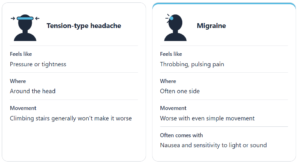
If your headaches sound more like migraine, ask a family physician or nurse practitioner: they can diagnose it, and only 40% of people living with migraine receive an accurate diagnosis.
When attacks keep returning, the hours spent waiting for the pain to pass add up, with dinners missed and evenings with family cut short.
Migraine can also make it harder to get on with work.
A Canada-wide study of 441 employed adults found that severe migraine-related disability was associated with about 110 more hours of lost paid and unpaid productivity over three months than little or no disability.
That’s nearly three 40-hour workweeks’ worth of lost productivity, across both paid work and home responsibilities. It’s not just sick days, it’s work and chores that simply don’t get done.
The disruption to home life and work reflects a much wider health burden.
The World Health Organization reports that migraine ranked third among neurological conditions for global disease burden in 2021, measured in age-standardized disability-adjusted life years.
Getting an accurate diagnosis remains another challenge. Migraine Canada’s report card on access to care estimates that only 40% of people living with migraine receive an accurate diagnosis.
What are the common symptoms and triggers of migraines?
The common symptoms of migraine are a throbbing headache, nausea, and sensitivity to light and sound.
Some people also experience aura, which can lead to visual disturbances. Stress, hormonal changes, disrupted sleep, and certain foods are all known triggers (the combination of triggers is of course different from person to person).
- Throbbing head pain often affects one side of the head and worsens with movement.
- Nausea accompanies many attacks, and some people vomit as well.
- Sensitivity to light and sound can make an ordinary room or conversation hard to tolerate.
- Visual disturbances during an aura may include flashing lights or zigzag patterns. Aura affects about 30% of people with migraine and typically lasts between 5 and 60 minutes, often appearing before a headache.
What brings on an attack is different from what makes someone prone to migraine.
Genetics account for about half of the risk of developing migraine, according to Migraine Canada’s report card. Its guidance on migraine triggers identifies several common factors:
- Stress at work or at home can set off an attack.
- Hormonal changes can trigger attacks in some women, particularly around menstruation, when attacks may be more severe.
- Sleep disruption from short nights and irregular bedtimes can contribute to attacks.
- Certain foods and drinks can trigger attacks in some people, with alcohol being one common example. Skipping meals may also bring on an attack.
- Weather changes and strong sensory input, such as bright lights or strong smells, may also trigger attacks.
Sometimes, it’s the combination of triggers that matters. A stressful day, poor sleep, and a missed meal, for example, may contribute to an attack.
A simple diary (even a notes app) can help you track your symptoms and possible triggers, spot patterns, and give your physician something concrete to review.
| When | How long | What you felt | Possible triggers | Medicine taken | Notes |
| Mon, 4 pm | About 8 hours | Throbbing on the left side, nausea, bright light hurt | Short night, skipped lunch, work deadline | Pain reliever at 5 pm | Eased by 9 pm |
| Sat, 10 am | Most of the day | Zigzag lines for 20 minutes, then a one-sided headache | Period started, bright sun | None | Rested in a dark room |
Example entries. Note every attack the same way and bring the diary to your physician and to your consultation. Then count the days in the medicine column: 10 or more a month for triptans or combination painkillers, or 15 or more for acetaminophen or anti-inflammatories alone, can lead to medication overuse headache.
How does a homeopathic consultation for migraine concerns work?
A homeopathic consultation for migraine is a structured interview about your symptoms, medical history, and daily routine. The homeopath uses that information to discuss any suggested remedy and the next steps.
At Soul Homeopathy, our migraine consultations are available by appointment at our Blue Spruce Street and Bramalea Road locations in Brampton. Here’s what a first visit may cover.
Your first migraine consultation, step by step

To get the most from the visit, bring your headache diary and a list of every medicine you take, including over-the-counter ones.
The homeopath can discuss those next steps, but there are limits to their role.
In Ontario, homeopaths can discuss their assessment findings but generally cannot communicate a medical diagnosis unless legally authorized to do so. Your physician or nurse practitioner should handle your migraine diagnosis and any changes to prescribed treatment.
What factors may influence someone’s decision to explore homeopathy?
People may explore homeopathy for several reasons, from previous treatment experiences to personal healthcare preferences.
- Individual healthcare preferences influence people who are drawn to remedies they believe are gentler or less likely to cause side effects.
- Interest in complementary practices may come from family members who have used homeopathy for years.
- Previous treatment experiences: Another medication, another disappointment, and still another migraine can leave people wondering what else to try. Migraine Canada explains that finding an effective preventive treatment can take time and may involve trying different medications.
- Broader lifestyle factors matter to people who want time to discuss sleep, stress, meals, and hormonal changes in a single visit.
These personal reasons may explain the interest in homeopathy, but they don’t in any way prove that the homeopathic remedies actually work to treat migraine. If you’re thinking of making any changes to your migraine treatment, you should talk to your doctor or nurse practitioner first.
Can homeopathy replace conventional migraine treatment?
No, homeopathy cannot replace conventional migraine treatment.
Research has not shown that homeopathic remedies reliably relieve or prevent migraine, so evidence-based medication, preventive treatment, and medical assessment remain the basis of care.
The NHS reports no good-quality evidence that homeopathy works as a treatment for any health condition.
Conventional treatment has a very different record, and the 2024 update of the Canadian Headache Society prevention guideline alone reviewed 61 controlled studies. The table below compares the two approaches.
| Factor | Conventional migraine care | Homeopathy |
| What it uses | Pain relievers, anti-nausea medicines, and triptans for attacks, plus preventive medicines | Highly diluted preparations that a homeopath chooses after an interview |
| Evidence for migraine | Randomized controlled trials, with strong Canadian Headache Society recommendations for several preventives | No reliable evidence of relief or prevention |
| Who provides it in Ontario | Family physicians, nurse practitioners, and neurologists | Homeopaths who hold registration with the College of Homeopaths of Ontario |
| Ability to diagnose migraine | Yes | No |
| Time needed to judge results | At least 2 months at the target dose for a preventive medicine | No evidence-based timeline |
| Appropriate role | The basis of care | An optional addition beside medical care |
Takeaway: homeopathy can sit beside medical care for migraine, never in place of it.
Replacing proven treatment has a predictable result.
Attacks continue without effective relief, people take painkillers more often, and frequent use can itself cause medication overuse headache. Migraine Canada places that risk at 10 or more days a month for triptans or mixed medicines, and at 15 or more days for acetaminophen or anti-inflammatories alone.
For that reason, we offer consultations at Soul Homeopathy as an addition to medical care and never as a substitute.
What should you consider before exploring complementary migraine approaches?
Five checks are important before you even consider a complementary approach such as homeopathy for migraine. They help you assess the practitioner, get a good understanding of the proposed treatment, and consider how it would fit in with your current migraine management.
Practitioner qualifications
In Ontario, only practitioners registered with the College of Homeopaths of Ontario can use the protected title ‘Homeopath’.
You can check a practitioner’s status, any restrictions and their disciplinary history via the College’s public register which is searchable by name or city.
Sukriti Vij, who leads consultations at Soul Homeopathy, is listed on that register as in good standing and holds a Bachelor of Homeopathic Medicine and Surgery from Delhi.

Treatment transparency
A transparent practitioner explains what a remedy contains, what the visit costs, and what the evidence says about its use before you pay.
For migraine, reliable evidence has not established homeopathy as an effective treatment. If a remedy is recommended, you can check whether it’s licensed in Canada by looking for its eight-digit DIN-HM number on the label and searching Health Canada’s product database.
That number confirms the product is authorized for sale, not that it works for migraine. Be wary of anyone promising a cure or asking you to keep the treatment from your doctor.
Potential interactions
Highly diluted homeopathic remedies are unlikely to interact with medicines, but not every product is diluted to the same degree.
Health Canada describes homeopathic products as generally low-risk, but some products may contain enough active ingredients to cause side effects or interact with medication.
Before taking a remedy, show its label to your pharmacist or physician, especially if you’re pregnant or take daily migraine preventive medication.
Medical supervision
While you’re looking at complementary care, your family doctor or nurse practitioner should still be the ones to look after your migraine diagnosis and your medicines.
Migraine Canada’s report card backs that approach, recommending primary care as the main source of care for the majority of people with migraine.
Keep your clinician up to date if you start on a homeopathic remedy or if you notice any change in your normal headache pattern.
Care delays
Complementary care should not delay migraine treatment backed by clinical evidence. Long waits for a headache specialist may be one reason people consider homeopathy in the meantime.
Migraine Canada’s report card notes that specialist waitlists can exceed 12 to 18 months. You don’t have to put treatment on hold during that wait: a family physician or nurse practitioner can diagnose migraine and start treatment.
The report also warns that managing migraine triggers should not delay medication when it’s needed, and the same principle applies to a homeopathic consultation.
Discuss Your Migraine Concerns at Soul Homeopathy
Migraines can impact your day to day life in terms of work, plans with friends and time with family.
If you’re worried about how frequently you’re having them or what might be triggering them, you can talk about it during an individual consultation at Soul Homeopathy’s two Brampton locations.
To arrange a visit, use the booking form on our website and provide your contact details and preferred date and time. Bring your headache diary and medication list to the appointment so we can review your migraine patterns and current care.
Frequently Asked Questions (FAQs)
Q1. Can migraines be cured naturally?
There is no known natural treatment or medicine that will cure migraine. Migraine Canada states that medication and good regular habits around sleep and meals will help people to manage their attacks.
Q2. Is there a way to stop migraines forever?
There’s no guaranteed way to stop migraine attacks forever. Preventive treatment can still make them less frequent, and your physician can help you decide whether medication is appropriate for your migraine pattern.
For many women, migraine also improves after natural menopause, though this doesn’t happen for everyone.
Q3. Does homeopathy work for migraines?
Reliable research has not established that homeopathy relieves or prevents migraine.
Some people still seek homeopathic consultations for more time to discuss their symptoms and daily habits. At Soul Homeopathy, these consultations are intended to take place alongside ongoing medical care, not replace it.
Q4. When should I see a healthcare professional about migraines?
A physician or nurse practitioner should assess headaches that disrupt your work or family life, or that require frequent medication.
Using triptans or combination pain medicines on 10 or more days a month is one reason to seek medical advice. Seek emergency care for a sudden, extremely severe headache or new symptoms such as vision loss or weakness.
A headache with fever and a stiff neck also needs immediate medical assessment, as Migraine Canada emphasizes the importance of assessing unusual headache symptoms.